
Postgraduate Medical Education in Singapore
Learn about the evolution of Singapore's Postgraduate Medical Education system, including the transition from the UK-based apprenticeship model to the current residency framework, and the establishment of a local accreditation framework.
Last updated on 11 August 2026
Background
Prior to 2010, Singapore’s postgraduate medical education had been modelled after the UK system, which was based on apprenticeship and summative assessments. Doctors spent their first year after graduation as interns (House Officers) to obtain their license to practise, following which, they could choose to undertake postgraduate medical studies. Specialty education began with basic specialty training (which was broad-based for internal medicine and surgical specialties), followed by more focused advanced specialty training (Figure 1). The traditional focus was training structured around hospital rotations under supervisors appointed by Heads of Departments. There was a high bar intermediate examination between the basic and advanced years, and an exit examination before doctor exited as a specialist.
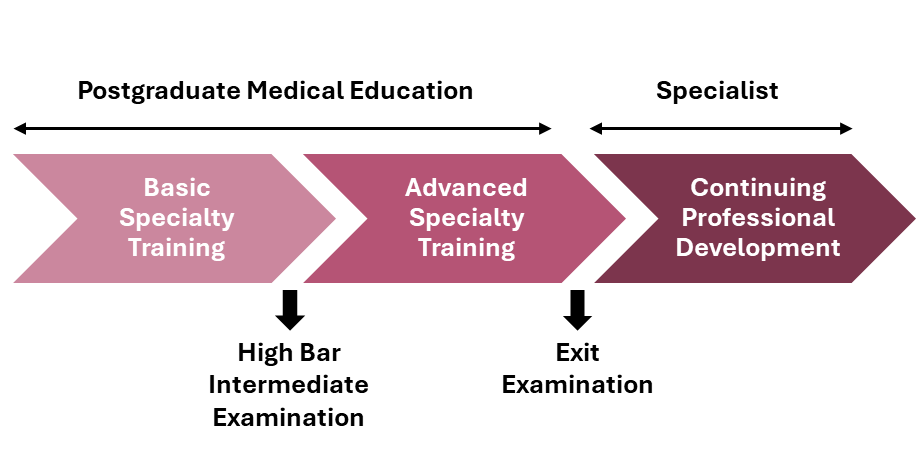
Figure 1: Postgraduate Medical Education system prior to 2010
The need for change
In 2006 and 2007, MOH conducted cross-sectional surveys and interviews with specialist and family medicine trainees on postgraduate medical training. The main concerns raised included the lack of training structure, and insufficient supervision and protected time for training.
First, despite previous efforts made to facilitate training (e.g. protected training time for trainees through appropriate funding, introduction of electronic logbooks), specialty training remained suboptimal. Protected time was rarely honoured and training was usually carried out on a voluntary and ad hoc basis, and commonly occurred after office-hours. Emphasis was placed on learning by the individual, rather than on training.
Second, the low pass rate for most of the UK membership examinations, together with the lack of a conducive training environment, deterred a significant proportion of doctors from continuing their training.
Third, there had been an overall increase in demand for specialist manpower to staff the upcoming hospitals. With the ramp up in the number of specialists being trained, there was a need to also ensure quality of training.
The urgency for change was catalysed by our ageing population, the increased number of trainees, the gradual erosion of the apprenticeship system due to service pressures and the need to improve postgraduate medical education to ensure good quality of patient care.
Between 2006 and 2007, MOH and the Specialists Accreditation Board (SAB) studied the graduate training systems of Australia, US, UK and Europe, and noted a consistent trend towards more structured and formative training in these countries. It was concluded that the most efficient training system was the US residency training system in which there was highly structured formative training, and where the assessment was continuous and standardised across all the institutions in the US.
In 2008, the SAB recommended to MOH that our postgraduate medical education be reformed and structured along the lines of the US residency model to provide a high yield of well-trained doctors for Singapore. The Residency postgraduate training system was hence officially introduced in phases from 2010 to 2013, in partnership with the Accreditation Council of Graduate Medical Education-International (ACGME-I).
There were four key components of postgraduate medical education which were restructured – curriculum, assessments, people and systems. A structured curriculum was established to achieve a defined set of objectives and core competencies, and residents were given graded responsibilities. Training was provided by designated faculty, and residents had to undergo regular formative assessments. These four components created a comprehensive matrix to ensure the quality of teaching and learning, and therefore, the quality of specialists.
Curriculum
The curriculum was contextualised to suit local needs (Figure 2). It detailed how conventional competencies of medical knowledge and patient care should be taught progressively, and visibly demonstrated and practised, so that residents could increase their responsibilities in a stepwise manner. Besides specialty-specific competencies, emphasis was also placed on general competencies, which were increasingly becoming more important.
Newer competencies such as professionalism, communication, practice-based learning, scholarly activities and system-based practice were also included in the curriculum.

Figure 2: The curriculum
Assessment
Regular formative assessments were introduced to provide timely and ongoing feedback to residents to help them better achieve the learning outcomes of the training programmes. Summative assessments were enhanced to include psychometrically validated Multiple Choice Question (MCQ) components, developed with the involvement of local examination workgroups.
People
The development of residency programmes involved the separation of the roles of training providers and regulators. Thus, the individual Sponsoring Institutions (SIs) were responsible for the selection of residents and administration of residency programmes.
Every SI had to ensure that their appointed Designated Institutional Official (DIO), Programme Directors (PD), Core Faculty and Programme Coordinators (Figure 3) had protected time to effectively carry out his/her educational and administrative responsibilities. This included the resources (e.g. time, space, technology and other infrastructure) to allow for effective administration of the Graduate Medical Education Office. Attention was also given to the training and development of the faculty.
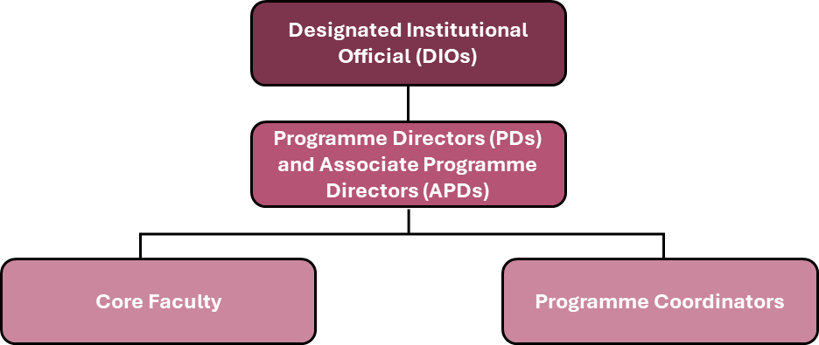
Figure 3: Key people in Sponsoring Institutions
Systems
A system of supporting organisational structures was put in place to provide the necessary checks and balances to ensure that residents were having the desired learning experience, and that teaching was conducted regularly and in accordance with plans (Figure 4).
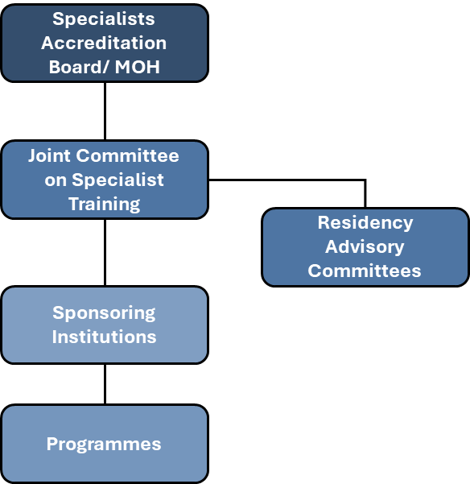
Figure 4: Organisational structure
Both internal and external reviews were carried out on a regular basis so that improvements in the system could be made. Internally, each SI was required to form the Graduate Medical Education Committee (GMEC), which was responsible for establishing and implementing policies and procedures regarding the quality of education and the work environment for the residents in all programmes. The GMEC was also required to develop, implement, and oversee an internal review by forming an internal review committee for each programme.
Residency Advisory Committees (RACs) were appointed by the SAB to oversee and provide advice on specialist training and assessment for the respective specialties. The RACs are overseen by the Joint Committee on Specialist Training (JCST), which is responsible for the professional standards and quality assurance of specialist training and assessment in Singapore.
Regular audits were conducted by the SAB-appointed accreditation body on the integrity of the institutions’ systems and the quality of the teaching processes.
Further enhancing postgraduate medical education
As our residency training framework matures, we recognise the need for training and assessment to be better contextualised to Singapore’s healthcare system. To enhance and sustain the quality of our local postgraduate medical education, a local accreditation framework called the Accreditation of Postgraduate Medical Education Singapore (APMES) was established in July 2023. The APMES is administered by the JCST.
The standards and requirements under APMES were developed by the local medical fraternity and took reference from various local and international practices. They have been adapted to be more aligned with local healthcare conditions and practices, so that residents will spend more time training to attain competencies that are relevant to the current and future healthcare needs of Singapore and are able to operate competently in the local clinical care environment.
We have also progressively introduced competency-based medical education through the implementation of Entrustable Professional Activities (EPAs). EPAs are units of professional practice (tasks) that can be entrusted to the resident with the right competencies to perform at the specified entrustment level, as assessed through workplace-based assessments.
The transition of all postgraduate medical training programmes onto APMES has been completed in July 2026.
Summary
The Residency system has allowed for the development of structured postgraduate medical education, with clearly defined curricula and regular formative assessments. Designated faculty are also given protected time to provide specialty training to residents.
Postgraduate medical education will continue to evolve with time in response to changing healthcare needs. We will continue refining our system by building on proven approaches and improving existing practices to ensure that it remains relevant and contextualised to meet Singapore’s needs.